

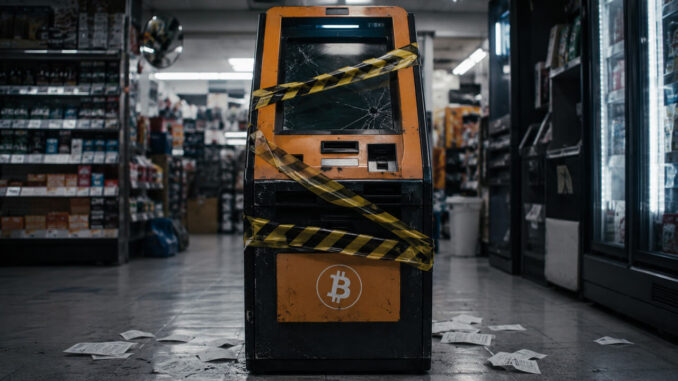



Bitcoin ATM company, Bitcoin Depot, filed for Chapter 11 protection on May 18 in the Southern District of Texas, announcing it would wind down operations and sell assets, and that its kiosk network, with over 9,000 locations globally as of August 2025, would go offline the same day.
A May 12 SEC disclosure showed that first-quarter revenue fell 49.2% year over year, gross profit collapsed by 85.5%, and management flagged “substantial doubt” about the company’s ability to continue as a going concern. The net loss for the quarter was $9.5 million, compared with net income of $12.2 million a year earlier.
Bitcoin Depot tied the deterioration to state and municipal restrictions, lower transaction limits, enhanced identity verification requirements, litigation, and more than $20 million in accrued legal judgments.
That accounting turns the bankruptcy into a regulated business, explaining how compliance requirements dismantled its economics.

MetricQ1 2025Q1 2026ChangeRevenue——-49.2% YoYGross profit——-85.5% YoYNet income / loss$12.2M profit$9.5M lossSwing to lossLegal judgment accruals—$20M+Balance-sheet pressure
What the machines were supposed to do
A Bitcoin ATM lets users exchange cash for cryptocurrency without linking a bank account, making Bitcoin accessible to cash-preferred customers, the underbanked, and anyone who wants in-person access without connecting to an exchange.
The model carried a structural problem from the start, as FinCEN puts kiosk fees at 7% to 20%, far above what centralized exchanges charge.
That pricing could sustain urgent or one-off cash conversions, but building a mass-adoption argument on 20% fees was always going to break down. The machines functioned as expensive on-ramps, and the economics of low-cost, repeat-use by consumers were always out of reach.
FTC data showed that reported Bitcoin ATM fraud totaled more than $65 million in the first half of 2024, with a median reported loss of $10,000. FBI data for 2025 recorded 13,460 complaints tied to crypto kiosks, with total reported losses of $389 million, representing a 58% jump.
Adults aged 60 and older accounted for roughly $257.5 million of that figure, and that concentration among older victims gave the regulatory backlash a political durability that standard anti-money-laundering enforcement rarely achieves.
Indiana enacted a statewide prohibition on virtual currency kiosks, Tennessee made installing or operating such kiosks a Class A misdemeanor, and Minnesota approved a ban set to take effect in 2026.
Bitcoin Depot’s bankruptcy connects those two threads directly, since stricter KYC controls cut transaction throughput, fraud warnings and lower limits reduced per-machine revenue, and litigation costs compounded the $20 million in accrued legal judgments already on its books.
The compliance measures that made kiosks safer stripped out the economic advantages that had made high fees defensible.
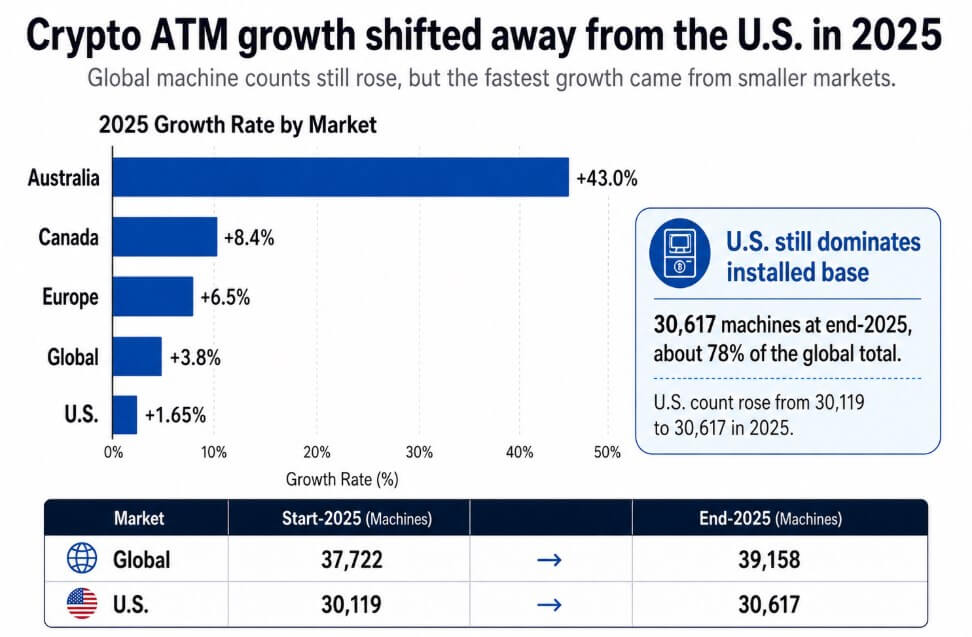
Finbold’s compilation of Coin ATM Radar data shows the worldwide Bitcoin ATM count rose from 37,722 to 39,158 in 2025, adding roughly four machines per day.
The US ended 2025 with 30,617 machines, about 78% of the global installed base, but grew only 1.65% from 30,119 at the start of the year.
Australia added 601 machines, a 43% increase, while Canada grew 8.4% and Europe grew 6.5%. The markets where kiosks are still expanding are those where regulators still treat the machines primarily as tools for financial access.

The two cases for crypto ATMs
In the bullish case, buyers could acquire viable Bitcoin Depot assets, selectively relaunch machines in states without outright bans, and global counts continue to climb.
Operators who absorb compliance costs run machines that function as regulated cash-conversion terminals with lower throughput and tighter margins.
Margins compress, but the product survives as a narrow, legal cash-to-crypto channel for users who cannot or will not use centralized exchanges.
Bitcoin Depot has said it intends to sell assets as part of an orderly process, which means the physical infrastructure could be transferred to new ownership and reopened.
In this scenario, kiosks resemble check-cashing stores with high fees, limited volume, real but narrow demand, and are sustainable only if operators accept thinner economics.
For the bearish case, if Indiana, Tennessee, and Minnesota represent a leading edge rather than outliers, the US installed base contracts sharply.
Each ban removes a portion of the 30,617 machines that represent nearly four in five global kiosks. Bitcoin Depot’s roughly 9,000 locations account for about 23% of the global total at year-end 2025. If those assets are not reactivated, the installed base takes a direct hit before any further state action compounds the loss.
If KYC requirements, transaction limits, refund obligations, and litigation exposure make high-fee kiosk operation unprofitable even without bans, the machines come down without regulatory intervention.
ScenarioWhat happens to machinesBusiness modelBitcoin adoption implicationBull case: regulated cash nicheAssets are sold, selected machines relaunch in permissive states, global growth continuesLower-margin, compliance-heavy cash-conversion terminalsATMs survive, but as niche infrastructureBear case: U.S. contractionState bans spread, Bitcoin Depot assets remain offline, operators exit high-risk marketsHigh-fee model breaks under KYC, limits, refunds, and litigationBitcoin adoption moves further toward exchanges, ETFs, wallets, and institutions
The cash bridge with no path to scale
Bitcoin adoption has moved well beyond kiosks, with Chainalysis estimating over $1.2 trillion in Bitcoin-to-fiat inflows to centralized exchanges from July 2024 to June 2025.
ETFs, mobile wallets, stablecoins, and institutional rails now carry the case for adoption. Chainalysis’s 2025 adoption index ranked India, the US, Pakistan, Vietnam, and Brazil as the top markets powered by exchange, mobile, and institutional rails.
Bitcoin ATMs gave cash-preferred users a physical on-ramp, made Bitcoin tangible in retail environments, and operated during a period when crypto still needed a real-world interface.
The distance between their fees and exchange-based alternatives was always too wide for mass adoption, and the use case that generated the highest-margin transactions also generated $389 million in reported fraud losses in a single year.
Machines in permissive states may survive as compliance-compliant cash conversion terminals, serving a narrow user base that still needs in-person cash access.
The rest leave behind a clearer record of how the crypto ATM dream was an expensive on-ramp that made Bitcoin visible without ever making it cheap, trusted, or repeatable enough to serve as mass-market infrastructure.



Be the first to comment