



Bitcoin fell sharply to $73,000 on February 3, extending a broader bearish trend that has now erased 41% from its October 2025 all-time high above $126,000. The drawdown has intensified debate over whether the market is approaching a cyclical bottom—or entering a deeper corrective phase.
The sell-off mirrors rising anxiety across traditional markets. US equity indices weakened amid concerns about artificial intelligence-driven disruption and escalating geopolitical risks, prompting investors to rotate away from risk assets.
In that environment, capital flowed back into traditional safe havens such as gold and silver, while Bitcoin failed to attract defensive demand.
Sponsored

Sponsored
Macro and Geopolitical Stress Push Investors Toward Traditional Havens
Bitcoin’s volatility continues to reflect macro sensitivity rather than isolation from global markets. The latest leg down coincided with renewed tensions between the United States and Iran after an Iranian drone was reportedly shot down near a US aircraft carrier.
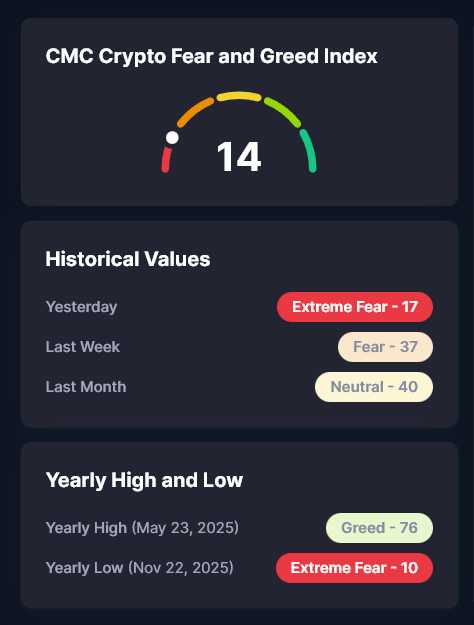
The incident pushed the VIX up roughly 10% and drove the Crypto Fear & Greed Index into “extreme fear” territory.
At the same time, developments in artificial intelligence—including new announcements around Anthropic’s Claude chatbot—sparked renewed concerns about disruption across the tech sector.
That uncertainty weighed on major technology stocks and further reduced appetite for speculative assets.
While Bitcoin declined, gold rose 6.8% and silver gained 10%, reinforcing their role as preferred hedges during periods of monetary and geopolitical stress.
Speaking to CNN, Gerry O’Shea, Global Head of Market Insights at Hashdex, noted that the divergence between Bitcoin and gold suggests investors still view precious metals as the primary safe haven during periods of uncertainty.
That shift has weakened Bitcoin’s short-term refuge narrative and added downside pressure.
Analysts Warn of Deeper Drawdowns and a Potential Bull Trap
Market participants remain divided, but several analysts are openly warning that the correction may not be over.
Sponsored
Sponsored
Crypto analyst Benjamin Cowen argued that Bitcoin’s near-term path is critical:
Other analysts are more pessimistic. Nehal, a widely followed trader on X, suggested the current structure resembles a classic bull trap, warning that the move lower may only be halfway complete.
According to Nehal’s historical comparison, Bitcoin’s previous cycles ended with drawdowns of 86% in 2018 and 78% in 2021.
Applying a similar framework to the current cycle implies a potential 72% decline, which would place Bitcoin near $35,000.
This cyclical perspective remains influential despite structural changes in the market, including ETF adoption and greater institutional participation.
Sponsored
Sponsored
On-Chain Data Signals “Bottom Discovery” Phase
On-chain indicators are adding another layer to the debate. Analyst CryptOpus noted that Bitcoin has entered what he describes as a “bottom discovery” phase for the first time this cycle.
At the 2025 peak, roughly 19.8 million BTC were held in profit. That figure has now dropped to 11.1 million BTC, a 40% reduction in profitable supply.
Historically, similar conditions have marked transitions from corrective phases toward cycle resets. In 2018, Bitcoin remained in this state for roughly eight months before stabilizing.
Key Technical Levels Under Scrutiny
From a technical standpoint, downside risks remain clearly defined. Nic, CEO of Coin Bureau, highlighted that Bitcoin has remained under pressure since breaking below the 50-week moving average in November.
Bitcoin is currently trading near MicroStrategy’s cost basis and close to the April lows around $74,400.
“If we break lower, the next major level is $70,000, just above the previous all-time high of $69,000. A clean break below that opens the door to a bear market target in the $55,700–$58,200 range, between realized price and the 200-week moving average,” Nic warned.
Sponsored
Sponsored
Conflicting Views on Whether a Bottom Is Near
Not all analysts agree with the bearish outlook. Michaël van de Poppe believes Bitcoin may already be nearing the end of its downturn.
Meanwhile, analyst David Battaglia focused on liquidation dynamics, describing current conditions as increasingly irrational.
Battaglia noted that below $85,000, liquidity gaps were significant, meaning panic sellers—whether institutional or whales—likely exited at suboptimal prices.
He contrasted this with the October 10 crash tied to Binance, which he described as structurally cleaner.
“Between $90,000 and $100,000, there’s massive short density and a 14:1 puts-to-calls imbalance, which under normal conditions already signals a strong bottom,” Battaglia said.
In Summary
Bitcoin’s drop to $73,000 has reignited fears of a deeper correction. Macro uncertainty, geopolitical tension, and mixed on-chain signals leave the market split between expectations of further downside and signs of an emerging bottom.
The coming weeks will likely determine whether this move represents a temporary pause—or the foundation of a new trend for 2026.


Be the first to comment